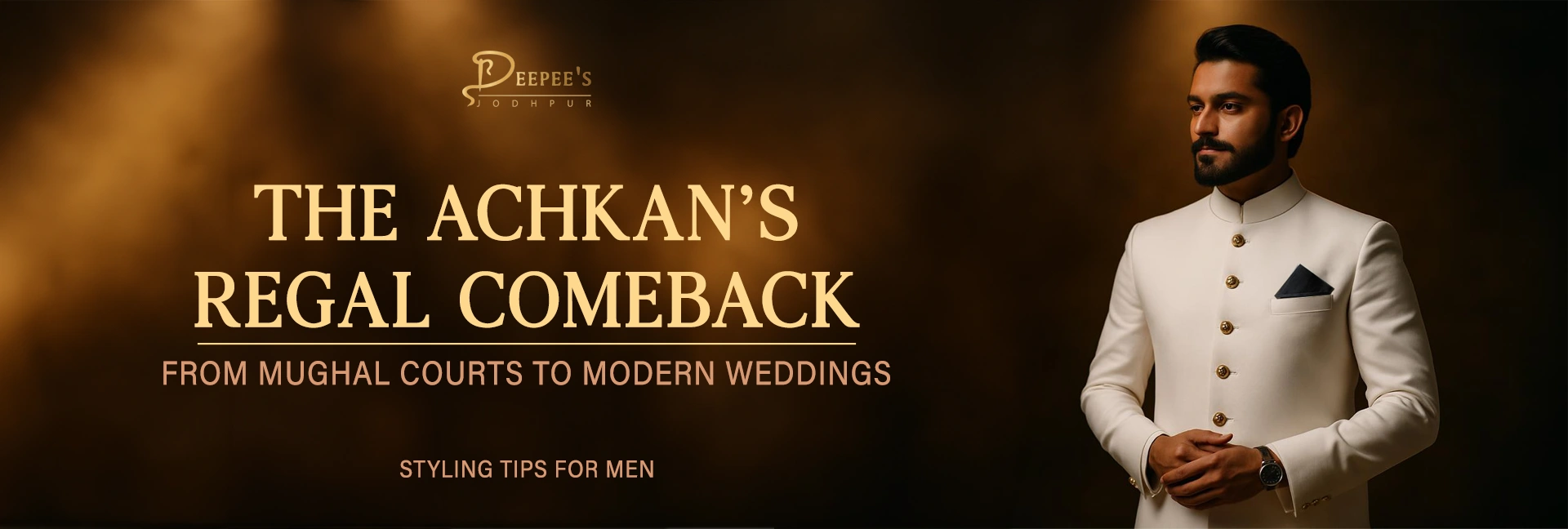

The Achkan’s Regal Comeback: From Mughal Courts to Modern Weddings

There was a time when kings wore it to court.
Now, grooms wear it to their big day.
The Achkan never left — it was just waiting for the right man to bring it back.

The Modern Man’s Achkan: Style with Substance

Today’s Achkan wearer isn’t just a groom. He could be a startup founder, a writer, a diplomat, or an artist. What connects them isn’t occupation — it’s intent. The Achkan has become a symbol of quiet confidence. It doesn’t try to impress. It simply holds presence.

In a world that often mistakes noise for power, the Achkan stands tall — clean, understated, timeless. It lets you make a statement without ever needing to raise your voice.Whether you’re walking into a wedding, a heritage property for a shoot, or a cultural celebration abroad — an Achkan shows the world you value roots, detail, and design with depth.
And that, in 2025, is the new luxury.

From Empire to Aisle: The Achkan’s Royal Roots

The Achkan traces its lineage to the opulence of Mughal and Rajput courts. Originally a formal court garment worn by nobles and courtiers, it was designed to be graceful yet understated — a reflection of royal etiquette and military discipline.
Its length, structure, and band collar set it apart from other traditional garments. While the Sherwani evolved as a ceremonial extension of this silhouette, the Achkan remained closer to its origins — minimal, elegant, and refined.
In princely states like Rajasthan, Hyderabad, and Awadh, it was common to see dignitaries and noblemen don Achkans for diplomatic gatherings and state functions. In many ways, it was India’s original power suit — long before the term existed.

What Defines an Achkan Today?

Though styles have modernized, the key elements of an Achkan remain beautifully intact:

  • Length: Typically knee-length or slightly shorter
  • Collar: Mandarin/band collar for a sharp neck frame
  • Structure: Slim-fit with subtle tapering at the waist
  • Detailing: Minimal embroidery, clean lines, and frontal placket buttons
  • Bottoms: Churidars, straight pants, or Jodhpuri trousers
  • Vibe: Quiet luxury with royal undertones

In contrast to the heavily embellished sherwani, the Achkan is more breathable, wearable, and incredibly versatile — perfect for the modern Indian wedding wardrobe.

How the Achkan Evolved Across India

While the Achkan has its roots in the Mughal courts of North India, it has quietly traveled across geographies — adapting to regional preferences while retaining its regal silhouette.

  • In Rajasthan, Achkans are often crafted in muted desert tones, paired with safas and mojaris — ideal for open-air palace weddings.
  • InLucknow, you’ll find Achkans in lighter pastels, often featuring delicate chikankari work — perfect for summer ceremonies.
  • In Punjab, grooms tend to favor deeper hues, bold buttons, and pair the Achkan with phulkari shawls or textured stoles.
  • In cities like Mumbai and Bengaluru, younger men are styling Achkans over shirts, pants, and even sneakers — proving it’s not just traditional wear, but a style language of its own.

No matter where it goes, the Achkan adapts — and becomes a reflection of the man who wears it.

Why the Achkan Is Back — And Here to Stay

As men move toward subtle luxury, there’s a clear shift from excessive embellishment to sharp tailoring and timeless silhouettes. Here’s why the Achkan is having a real renaissance:

Minimalism Meets Royalty

Its clean construction allows you to stand out without looking overdressed. It speaks to the modern man’s desire for impact with intention.

Perfect for Destination Weddings

Lightweight, versatile, and elegant — Achkans travel well and look great in palaces, hill stations, or beach resorts.

Works Across Generations

Whether you’re 25 or 55, the Achkan adapts to your style — classic or contemporary.

Day-to-Night Transition

Wear a lighter-toned Achkan for a day event and swap in darker hues with minimal accessories for a night ceremony.


Fabrics & Seasons: Choosing the Right Achkan

Selecting the right fabric is key to comfort and flair. Here’s a quick guide:

Fabric

Best For

Ideal Season

Suiting Blends

Engagements, reception, day weddings

Year-round

Silk Blend Jacquard

Regal weddings, festive occasions

Winter / Night events

Raw Silk

Minimal traditional events

Autumn / Winter

Linen-Cotton Mix

Fusion wear, summer weddings

Spring / Summer

💡 For summer functions, avoid brocades and opt for soft, breathable textures in ivory, beige, or pastel tones.

The Achkan Groom: How to Style It on Your Big Day

You don’t need a sherwani to look like royalty. Here’s how modern grooms are embracing the Achkan with confidence:

Ivory & Gold Elegance
  • Achkan in raw silk with tone-on-tone embroidery
  • White churidar, brocade stole, and handcrafted mojaris
  • Add a layered pearl mala or vintage brooch for detail
Emerald or Maroon Drama
  • Deep jewel-toned Achkan in jacquard
  • Paired with contrast pants and textured dupatta
  • Safa and heritage rings complete the regal look
Pastel Sophistication
  • Light blue or mint green Achkan in linen silk
  • Neutral churidar, tan juttis, and a soft floral pocket square
  • Ideal for day weddings or breezy hill station venues

Achkan vs Sherwani vs Bandhgala – A Quick Recap

Outfit

Visual Language

Best For

Fit & Feel

Achkan

Minimal + Royal

Engagements, grooms, day weddings

Slim, sleek, breathable

Sherwani

Grand + Ornamental

Grooms on wedding day

Heavily layered, rich

Bandhgala

Short + Tailored

Receptions, cocktails

Western + formal

Accessorizing the Achkan: Less Is More

The Achkan is already a refined piece — you don’t need to overdo it. When styled right, even the simplest Achkan can look like a bespoke heirloom. 
Here are some foolproof accessory ideas:

Brooch or Lapel Pin

A subtle antique brooch can elevate the chest area without overpowering the look.

Layered Mala or Chain

Great for grooms or brothers of the groom. Choose neutral pearls or polished stones.

Pocket Square

If you skip the brooch or mala, a pocket square adds sharp contrast.

Safa (Turban)

Adds volume and height — especially suited for grooms.

Minimalism Meets Royalty

Its clean construction allows you to stand out without looking overdressed. It speaks to the modern man’s desire for impact with intention.

Fashion Tip

Pro tip from Deepee’s stylists: When in doubt, subtract. Let the fabric, fit, and cut do the talking

Deepee’s Signature Achkans: Tailored in Time

At Deepee’s Jodhpur, the Achkan is not a design experiment — it’s a legacy we’ve refined.
What makes ours different?

  • Structured yet fluid tailoring to ensure ease of movement
  • Subtle hand finishes like antique buttons and contrast inner linings
  • Fabric curation from suiting mills, handloom clusters, and artisanal dyeing units
  • A color palette that ranges from timeless classics to contemporary pastels

Whether you’re dressing for your wedding, your brother’s big day, or a destination celebration — a Deepee’s Achkan ensures you walk in like you belong.

Designer’s Insight: A Revival Rooted in Restraint

“The Achkan is for men who don’t need drama to command attention. It carries centuries of design discipline — and we simply give it a modern heartbeat.”
Abhishek Trivedi, Celebrity Designer, Deepee’s Jodhpur

Conclusion

The Power of the Understated

When you walk in wearing an Achkan, you don’t need to announce yourself.
Because heritage never begs for attention — it commands it quietly.
Explore Deepee’s Achkan Collection — available in-store and online at  www.deepeesjodhpur.com 


Achkan – Frequently Asked Questions

An Achkan is a traditional long coat worn over a kurta, typically knee-length, with a band collar and minimal detailing. It originated in Mughal courts and is now a popular choice for weddings, engagement ceremonies, and formal events

Yes, modern grooms increasingly prefer Achkans for their wedding day. They offer a regal look with more comfort, especially for summer or daytime ceremonies.

Popular fabrics include raw silk, suiting blends, jacquard, and linen-cotton mixes. The choice depends on the season and occasion. For weddings, silk blends or jacquard work well. For summer or daytime events, opt for lighter fabrics like cotton-linen.

Absolutely. Achkans in lighter fabrics like suiting blends or cotton-silk are ideal for warm weather, especially for outdoor or daytime weddings.

 An Achkan is lighter, more fitted, and less ornate than a Sherwani. While both are worn for formal occasions, Sherwanis are usually heavier, longer, and worn by grooms on their wedding day. Achkans are ideal for engagement functions or as a groom’s alternative to the Sherwani.

Achkans are best paired with churidars, slim-fit trousers, or Jodhpuri pants. For a more traditional look, stick to churidars in a complementary tone.

Yes, modern fusion styles allow Achkans to be worn directly over dress shirts or turtlenecks, especially for receptions or Indo-western events. Traditionally, though, they are worn over a kurta.

You can shop premium tailored Achkans at Deepee’s Jodhpur, known for their elegant cuts, heritage fabrics, and modern styling. Visit the store or explore online at www.deepeesjodhpur.com.

Shopping Cart (0)

Cart

WeCreativez WhatsApp Support
Our customer support team is here to answer your questions. Ask us anything!
👋 Hi, how can I help?